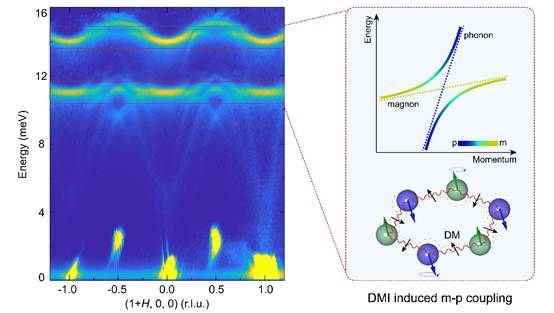
Reporting the discovery of topological magnon polarons in a multiferroic material Fe2Mo3O8, Professor Jinsheng Wen’s group published a paper entitled “Direct observation of topological magnon polarons in a multiferroic material” in Nature Communications [Nat. Commun. 14, 6093 (2023)] in collaboration with Prof. Jian-Xin Li’s group at the School of Physics.
Magnons and phonons, quanta of spin waves and lattice vibrations respectively, constitute two fundamental collective excitations in ordered magnets. When these two entities are strongly coupled, intriguing collective excitations known as magnon polarons can emerge. They possess hybrid magnonic and phononic signatures, and are responsible for many exotic spintronic and magnonic phenomena. They can provide a phonon-involved way to generate and manipulate spin currents carried by magnons thanks to their hybrid nature, signifying promising potentials in spintronics technology. Despite long-term sustained experimental efforts in chasing for magnon polarons, direct spectroscopic evidence of their existence is hardly observed. In this work, the team report the direct observation of magnon polarons using neutron spectroscopy on a multiferroic Fe2Mo3O8. They unambiguously identify two distinct hallmarks of magnon polarons: the appearance of a gap at the nominal intersection of the original magnon and phonon bands, along with mixing, interconverting and reversing between the magnonic and phononic components. They attribute the formation of magnon polarons to the strong magnon-phonon coupling induced by Dzyaloshinskii-Moriya interaction. Intriguingly, it is found that the band-inverted magnon polarons are topologically nontrivial. These results uncover exotic elementary excitations arising from the magnon-phonon coupling, and offer a new route to topological states by considering hybridizations between different types of fundamental excitations. Our work, in conjunction with our recent publication in Nature Physics [https://doi.org/10.1038/s41567-023-02210-4], underscores the emergence of novel phenomena driven by the strong magnon-phonon coupling.